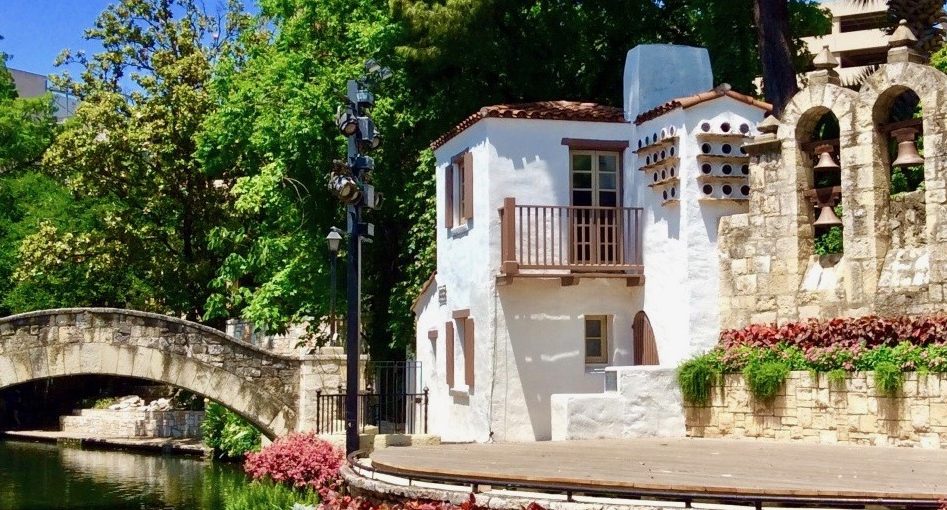
330 years ago today, on June 13th, 1691, a Spanish expedition led by Domingo Teran de los Rios, reached the banks of a slow-moving river and set up camp. The region was inhabited by the Payaya Indians, a hunting and gathering nomadic peoples. They called the river Yanaguana (place of refreshing waters).
Father Damian Massanet, accompanying the Spanish explorers, celebrated Mass on what was the Feast of St Anthony de Padua, and the name “San Antonio de Padua” was bestowed upon the area.
There are differing accounts as to who actually came up with the name on that day. Father Massanet wrote in his diary:
“We found at this place, the rancheria of the Indians of the Payaya nation. This is a very large nation and the country where they live is very fine. I called this place San Antonio de Padua, because it was his day. In the language of the Indians, it is called Yanaguana. The river is bordered by many trees: cottonwoods, oaks, cedars, mulberries and many vines. There are lots of fish and prairie hens.
I ordered a large cross set up, and in front of it built an arbor of cottonwood trees, where the altar was placed. All the priests said mass. High mass was attended by Governor Don Domingo Terán de los Rios, Captain Don Francisco Martinez, and the rest of the soldiers. The Indians were present during these ceremonies. Then I distributed among them rosaries, pocket knives, cutlery, beads and tobacco. I gave a horse to the Payaya chief”
This mass is remembered with the wrought-iron sculpture “Padre Damian Massanet’s Table,” by San Antonio artist Rolando Briseño, located today on what is commonly known as “Marriage Island,” which is on the San Antonio River between the Presa and Navarro Street bridges.
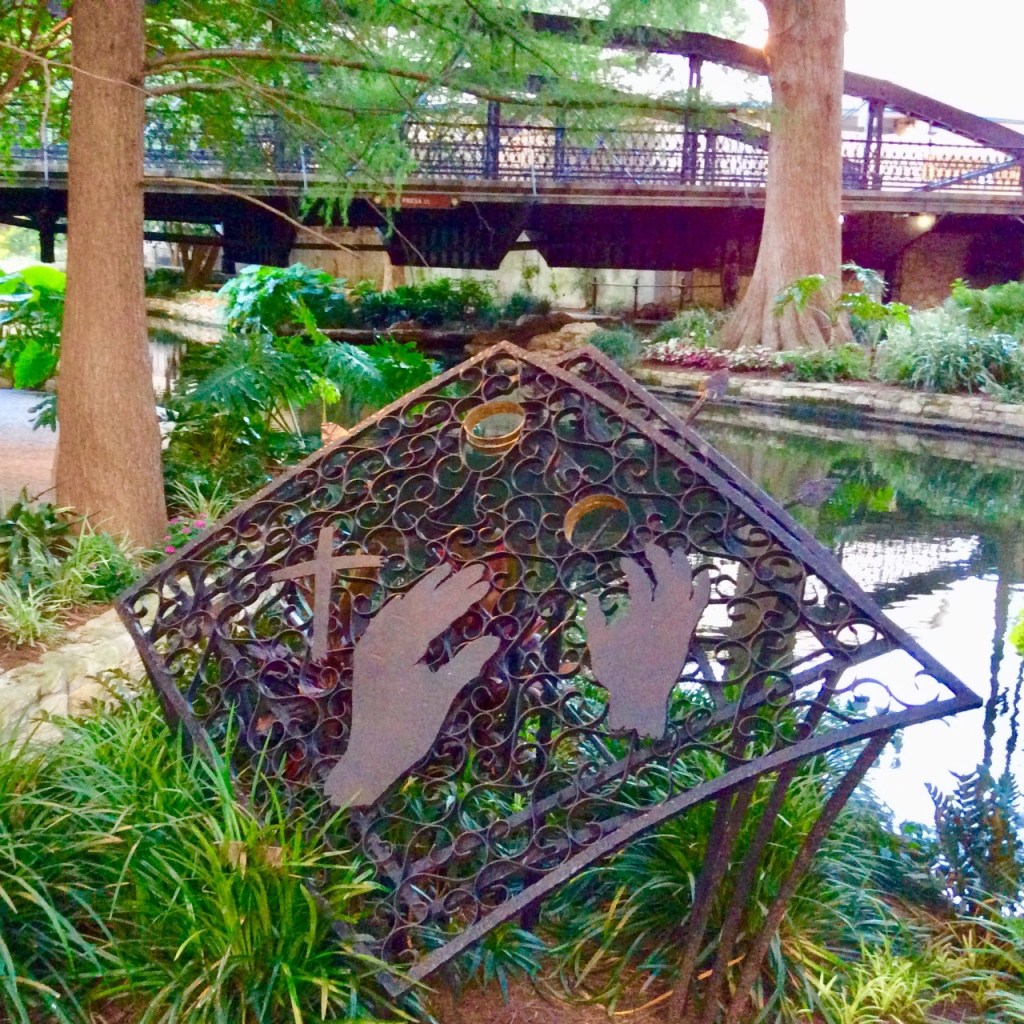
Photo: Author

Photo: Author
The leader of the expedition, Domingo Terán de los Rios, mentioned by Father Massanet, also recorded his account of the events that day, and after noting large numbers of buffalo:
“We camped on the banks of an arroyo, adorned by a great stand of trees, cedars, willows, cypresses, osiers, oaks and many other kinds.
This I called San Antonio de Padua, because we had reached it on his day. Here we found certain rancherias in which the Payaya nation live. We observed their actions, and I discovered that they were docile and affectionate, were naturally friendly, and were decidedly agreeable towards us.”
There are also differing opinions as to the exact location where the mass was held.
Many think it was on Marriage Island, however, because the island is primarily made of a root ball from a 150 year old cypress, it is thought the mass was held somewhere else in this vicinity. There is actually another artwork, commemorating the mass, located near La Villita just near Rosita’s Bridge, a few hundred yards east on the river. Many believe this is closer to the true location of the mass that day.

Photo: Author
Whichever version you believe ( Historians are divided ), the consensus is that the mass was held on June 13th 1691, 330 years ago today, and the area was given the name, San Antonio for the first time on that day.
Additional information:
* Artist Rolando Briseño has more artwork on the San Antonio River. On the Museum Reach section, at the McCullough Street bridge, he created a red metal ribbon of hands called “Bridge of the Encounters”, and at the Brooklyn Avenue bridge, you will find “Bridge of Rippling Shadows.”
* According to geologist, William Feathergail Wilson, in his 1970 paper, “Water Quality Planning – Alamo Area Council of Governments,” there are some who believe that the river had another name, pronounced by the early local inhabitants as “ Chem-quem-ka-ki”, which reportedly translates to “Old man coming home from the lodge”. The origin of this name is unknown.
* Marriage Island, approximately 25 feet long and 15 feet wide, has been the chosen location for thousands of weddings….and the estimate is that at least 300 are held there each year. It is also a very popular spot for proposals and vow renewals.

Photo: Author

Photo: Author
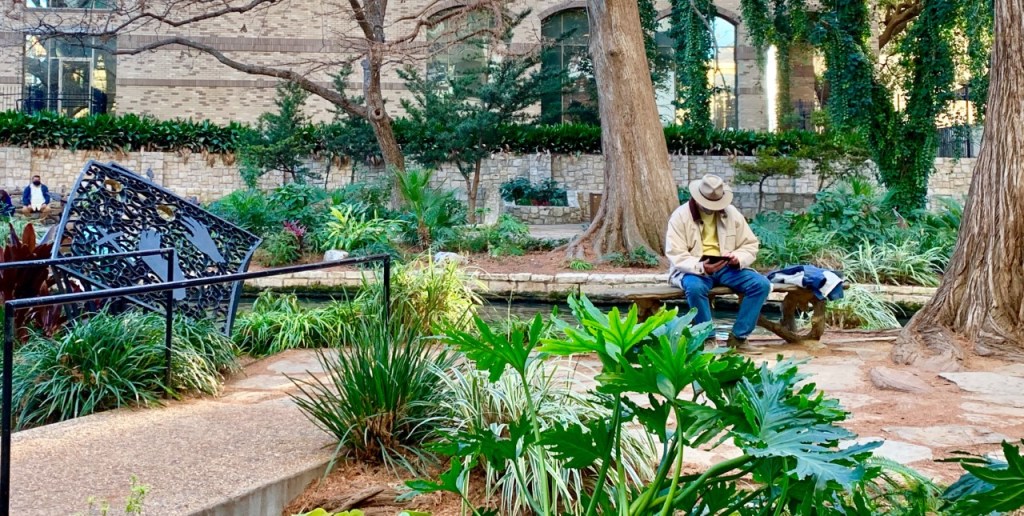
Photo: Author on Marriage Island
Sources:
“San Antonio— A Historical and Pictorial Guide” Charles Ramsdell
“American Venice” Lewis F. Fisher
“San Antonio— The Story of an Enchanted City” Frank W. Jennings
“A Dream Come True” Vernon G. Zunker
Follow My Blog
Get new content delivered directly to your inbox.
 Memories of San Antonio