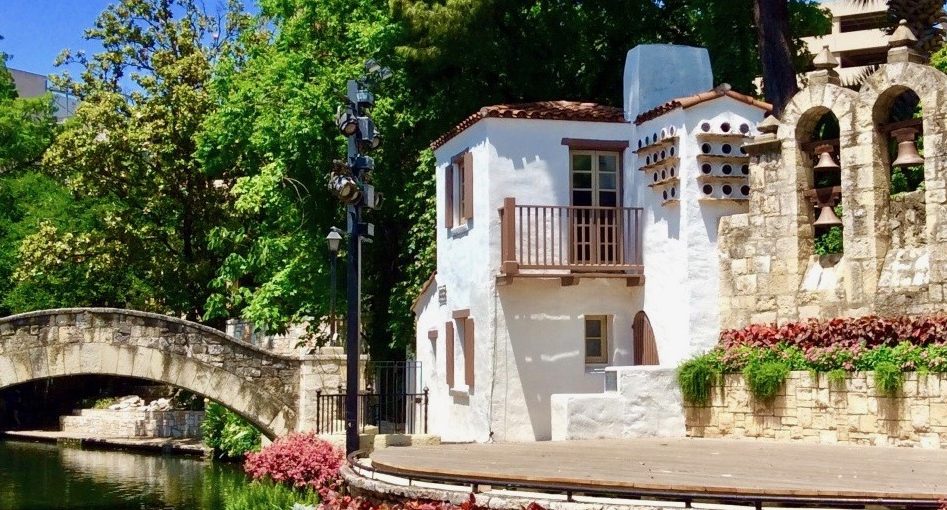
Born into a family of 11 children in San Antonio, and due to a degree of poverty in her family, a young Emma lived with her grandparents. During this time, she learned a lot about her Mexican identity, and through her grandfather, Francisco Zepeda, a lot about his passion for social justice.
While growing up on San Antonio’s West Side, she would accompany her grandfather to the Plaza del Zacate, located in what is now known as Milam Park. It was here that she was witness to speakers, who attracted crowds to the plaza, and led discussions on civil issues and politics.
After graduating from Brackenridge High School, she worked as an elevator operator at the Gunter Hotel, she sold goods door-to-door and washed jars at a pickle factory. Emma denounced her Catholic upbringing, and declared herself a Communist. She became aware of inequalities in wealth and the poverty that existed amongst Hispanic workers. She became an activist with others, who shared the common goal of organizing female workers across San Antonio. This led to the formation of the Workers Alliance to fight discrimination at a time when New Deal programs were supposed to support workers as America recovered from the Great Depression. She organized protests and strikes, and was arrested twice.
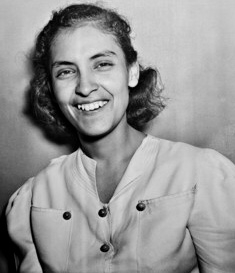
Photo: texasstandard.org
Many of the people she was fighting for were living in poverty because of the low wages they were paid as pecan shellers, one of the largest industries in San Antonio at that time. In fact, during the 1930’s, San Antonio provided almost 50% of the pecan industry in the United States. Many of the workers in these factories were women working for meagre wages like $2 – $3 a week, working 10 hours a day, seven days a week. The conditions inside the factories was abysmal with poor light, inadequate ventilation and unsanitary facilities. As a result, the rate of tuberculosis was high amongst those who were employed there.
On January 31st 1938, the then 21 year old Emma Tenayuca, led a city-wide strike by these desperate workers, who walked off the job in protest of their conditions and pay. Most of these protesters were women with the number estimated to be 12,000, and as a result, these factories were shut down for three months.
The San Antonio Mayor, Charles Kennon Quin, sent in police forces to break up the picket lines and disperse the strikers with tear gas; however, the workers resisted and did not back down. National attention was brought to their plight and to Emma Tenayuca. However, her links to the Communist Party saw her removed as the leader of their protests because others saw her as a target, and a possible distraction from their cause. Despite this, she remained active in their struggle by giving support and speeches, and she inspired many to stand up for their beliefs and their rights .
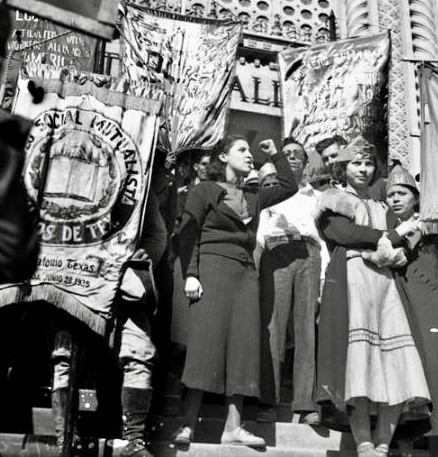
Photo: The Mujerista
The striking shellers agreed to take their case to arbitration, and the Texas Governor, James Allred, convinced the pecan-shelling companies to abide by the decision of a 3-man arbitration board. As a result, the pay was subsequently increased for the shellers. Congress then passed the Fair Labor Standards Act, and established the minimum wage of .25 cents per hour. Fearing that this Act would encourage the mechanization of these factories, there was a push by The Congress of Industrial Organizations and employers’ associations, seeking an exemption from this newly-passed law for pecan-shellers in Texas. However, this was denied, and as a result, due to the higher wages, the shell-cracking machines were gradually reinstalled over the next three years, and thousands of workers in the factories were replaced.
In 1938, Emma Tenayuca married Homer Brooks who was a well-known leader of the Communist Party, and a former candidate for the Governor of Texas. The two were described as a “power couple” from their public appearances and articles that they co-wrote.
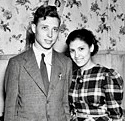
Photo: Emma Tenayuca and Homer Brooks…Wikipedia
Emma Tenayuca continued with her fight for worker’s rights, but for her personal safety, she left San Antonio in 1939. This followed a function at the Municipal Auditorium that was held on behalf of the Communist party. An estimated 5,000 protesters gathered outside, and Emma was ushered out through a secret underground passage under police protection. She subsequently moved to Houston, and later to California, where in 1945, she ended her association with the Communist Party.
Emma turned her attention to furthering her education, and completed her undergraduate degree in SanFrancisco, which led her to a career in teaching. She quietly returned to San Antonio in 1968, where she earned a master’s in education at Our Lady of the Lake University.
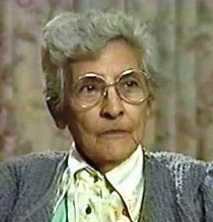
Photo: The Top Shelf…wordpress.com
As time went on, she was lauded for her actions and support for worker’s rights, and she was inducted into the San Antonio Women’s Hall of Fame in 1991. Emma Tenayuca passed away in 1999 at the age of 82 after being diagnosed with Alzheimer’s disease.
Many say that although a diminutive 5’1” tall, Emma Tenayuca became a giant in the battle for the rights of Mexican Americans. She was born on this day in 1916.
Today, a plaque in her honor stands in Milam Park.

Photo: Author
Sources:
Texas State Historical Association Handbook of Texas
Women & The American Story
The San Antonio Report
National Park Service…nps.org
biography.com
“San Antonio Uncovered” Mark Louis Rybczyk
“San Antonio 365” David Martin Davies & Yvette D. Benavides
Library of Congress: guides.loc.gov
uiw.edu
Follow My Blog
Get new content delivered directly to your inbox.
 Memories of San Antonio