Waldine Amanda Tauch ( pronounced as in “cow”) was born in Schulenburg, Texas on January 28th, 1892….130 years ago today. Her father, William, was a photographer who encouraged her artistic abilities, and she believed that she got a lot of her talents from him. On the other hand, her mother wanted her to get married and have children.
She recalled that when she was 7 years of age, a friend of her mother brought a beautiful, intricately carved, German ivory bookmark to their house, and she fell in love with it.
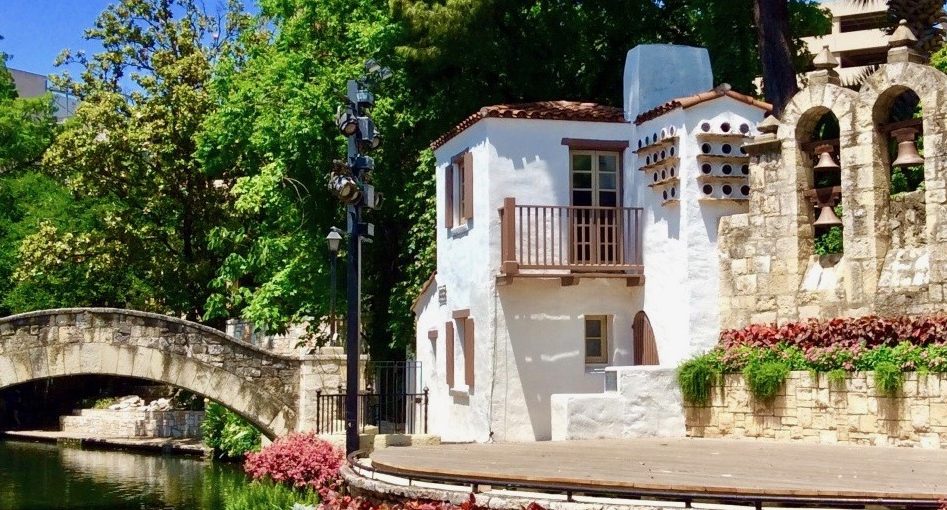
She continued her craft working with chalk, clay, stone, soap and wood. Her family moved to Brady, Texas, between Austin and San Angelo because of her father’s failing health. When she was in her teens, the Brady Tuesday Study Club, realizing her incredible talents, requested her to create a luncheon centerpiece made of butter. They were so impressed with the sculpture, they raised money on her behalf, and she was introduced to famous sculptor Pompeo Coppini, who had a studio in his home, on the corner of Broadway and Arcadia Place in San Antonio.

Photo: Coppini San Antonio home…The Lost Coppini Statue Project
Coppini completed many memorable works of art around San Antonio, and probably the most notable is the Alamo Cenotaph.
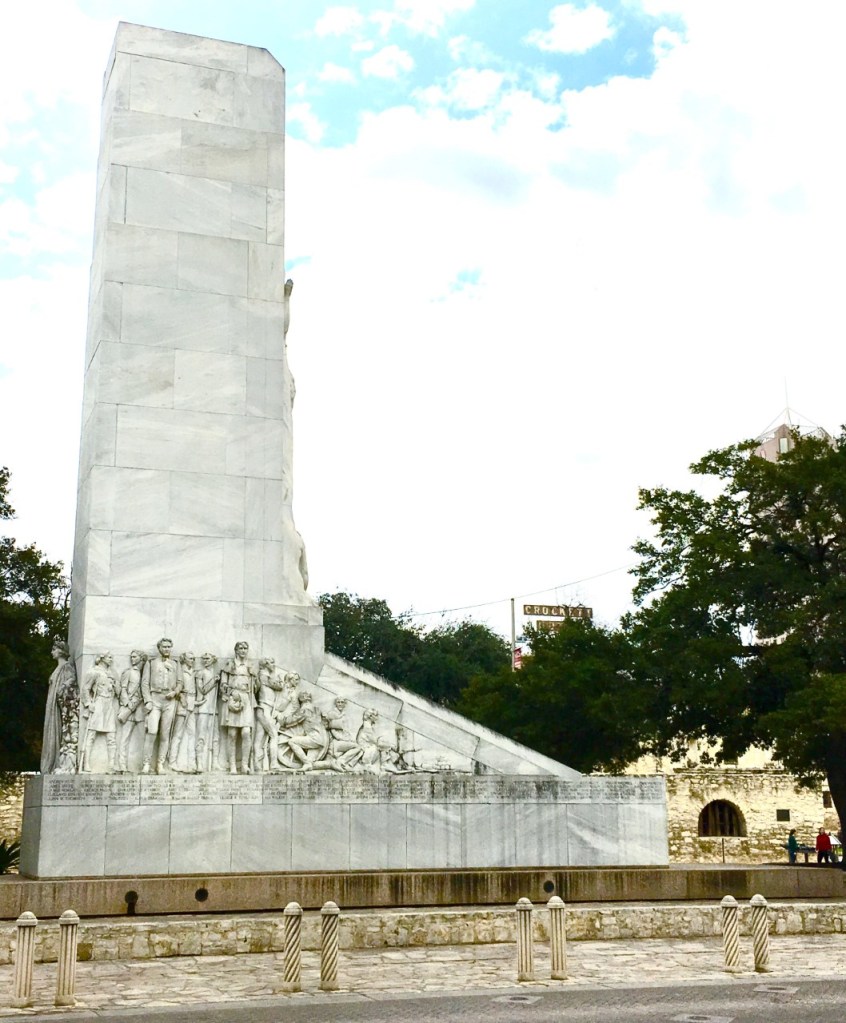
Photo: Author
Waldine moved to the city in 1910, at the age of 18, and became Coppini’s protege because he was so impressed with her raw talent. In time, the funds to support her dried up, and she was forced to move back to Brady; however Coppini was so impressed with her that he summoned her back to San Antonio and taught her free of charge. She was raised as a foster daughter in his home.

Photo: Waldine in the Coppini studio…Fayette Public Library
Her first public work in San Antonio is probably her best-known in the city. It is called “The First Inhabitant,” and it can be found on the Commerce Street bridge near the “Torch of Friendship.” She was commissioned to create the sculpture of the Native American as part of the new bridge that was built there in 1915.

Photo: The First Inhabitant….Author
The sculpture created by Waldine Tauch depicts a 7 foot tall Native American in full feathered headdress, bordered by a backdrop of corn. The figure holds a small bowl in each hand, and these were originally drinking fountains, long since removed. Waldine Tauch was paid $1,000 for the sculpture.
She soon developed a passion to sculpt heroic public monuments. Coppini opposed this because he felt with her small stature ( she stood 5’ 5 1/2” tall ) that she would not have the strength needed to be able to complete the physical tasks required in these larger-than-life works. However, she believed in her abilities, and those who saw her at work over the years were amazed at her ability and stamina climbing ladders to complete the “skeleton,” known as an armature, of a tall sculpture, which is made from boards and pipes, and then packed it with clay to complete the figure.
In the ensuing years, she followed Coppini, first to Chicago and then to New York, helping him to finish some of his projects, but in the mid-1930’s, Waldine Tauch returned to San Antonio, so that she could compete for commissions that were inspired by the Texas Centennial celebration in 1936.
Consequently, she was awarded the commission to create “The First Shot Fired For Texas Independence”, a life size bronze sculpture set in granite, and located a few miles southwest of Gonzales, Texas, at a cost of $9,300.

Photo: Texas Historical Commission
Interesting to note, that she was awarded this commission ahead of Gutzon Borglum, a renowned, nationally-recognized sculptor who was also in San Antonio, and is responsible for the Mount Rushmore monument. See an earlier post here about Gutzon Borglum and his incredible artistic contributions.
In the mid 1940’s, Waldine teamed up with Pompeo Coppini to create a studio in San Antonio. This was a place where they could both work and instruct budding artists.
She was recognized by many arts groups throughout her life. In 1964, Waldine Tauch was elected a Fellow of the National Sculpture Society of New York City.
Then five years later, the Texas Senate presented Waldine Tauch an award for sculpting outstanding Texans, stating that her general patriotism added to the culture of Texas.
Waldine is responsible for the statue in front of the Chapman Graduate Center at Trinity University in San Antonio, which is called “Education Reflects Responsibility Into The World.” Waldine had taught at Trinity University between 1943 and 1945 when Pompeo Coppini was head of the art department there. In 1965, the university asked her to create a sculpture for the campus. When designing the statue, she found a young male model whose facial features were exactly what she was looking for; however, his body was too slight for her vision for the statue. So she engaged another model because of his torso. But, she did not like this model’s legs, and so a third subject was brought in who had more appealing legs to complete the artwork, which is in fact, a composite of three young men.
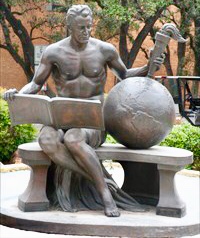
Photo: Waymarking.com
The commission that she most desired came her way in 1966 when she was 74 years of age…an 8 foot high statue of General Douglas MacArthur for Howard Payne College in Brownwood, Texas, where she had received her Honorary Doctorate of Fine Arts. She revealed in interviews that when a sculptor is creating a life size statue, the first step is to create the subject nude….and then the clothing is added later. She had quite a few tongues wagging when people would walk in to see a nude statue of General Douglas MacArthur wearing only a hat and shoes as she worked on the other clothing.

Photo: Women Out West: Art On The Left Coast
Around San Antonio, Waldine Tauch has left her mark with other memorable sculptures and works of art. There is the Baptismal Font in the Grace Lutheran Church, sculptures at the Witte Museum, Mirabeau Lamar on the Alamo grounds, and the 10 foot high statue of Moses Austin behind City Hall, in front of the Spanish Governor’s Palace, which took her two years to complete.

Photo: Author
It has a series of bas reliefs around the base of the statue showing scenes from the life of Moses Austin. Waldine Tauch recalled the creation and the carving of the inscription on the pedestal, which she said was a laborious job, and her least favorite task with a statue. It took weeks to complete, and then she was given the news that the information given to her for the inscription was incorrect, and the lettering would have to be redone.
She was reportedly furious at this news, but she had to scrape the original lettering from the pedestal so that the correct information could be installed on the base.

Photo: Author
Waldine Tauch continued to sculpt and instruct well into her eighties. However, her eyesight was failing, and she passed away in San Antonio on March 31st 1986 at the age of 94.
Her final resting place in San Antonio is with her mentors the Coppinis, and her legacy lives on today not only in her amazing sculptures around the United States, but in the Coppini Academy set up for aspiring artists.
Photo: mountolivethistory.com
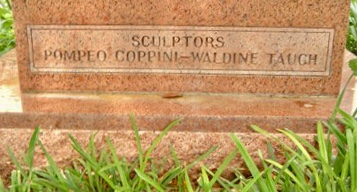
Photo: Genius of Music
Additional story:
In June 2020, Dallas authorities removed the Waldine Tauch statue of a Texas Ranger which had been located in the main lobby of the Love Field airport. Due to protests, according to an airport spokesman, the statue was placed in storage with its fate to be decided by the Dallas Office of Arts and Culture. The 12 foot high bronze statue had been there since 1963.
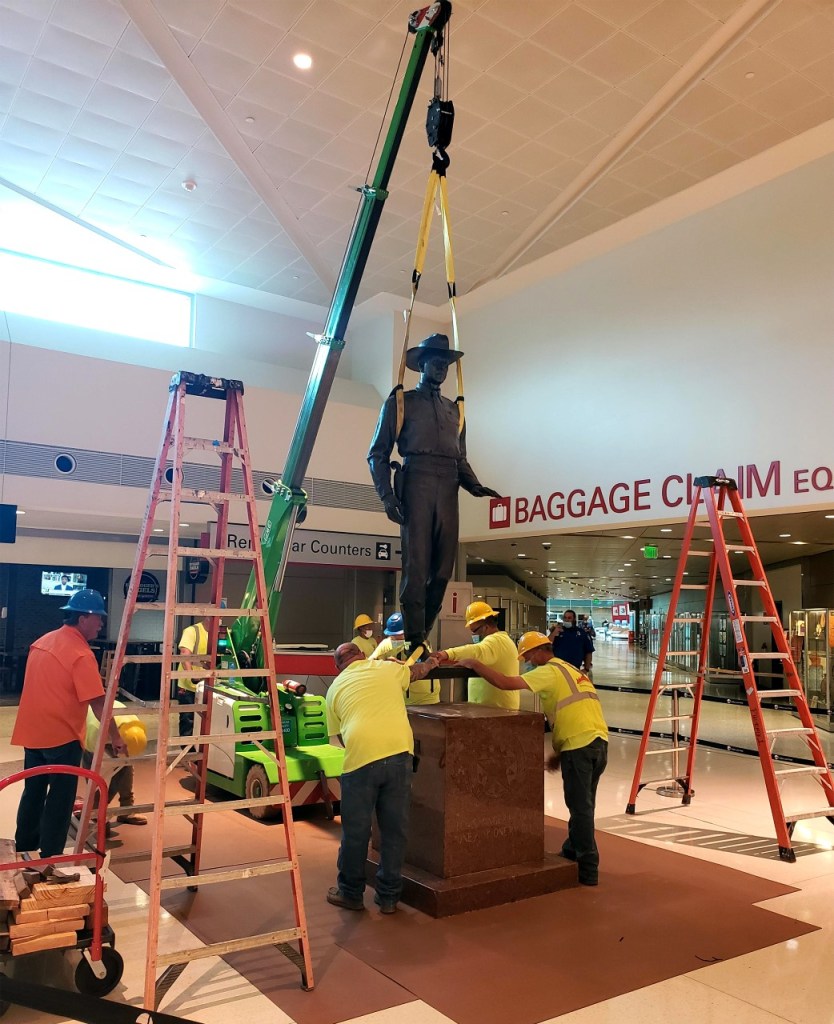
Photo: NBC News
Sources:
tshaonline.org
digital.utsa.edu
San Antonio Express News January 10 1936
vimeo.com
myrahmcilvain.com
Follow My Blog
Get new content delivered directly to your inbox.
 Memories of San Antonio