Augustine Honoré Grenet was born at Monthois, Ardenne, France on September 6th, 1823. Today we remember him on the 200th anniversary of his birth.

Photo: Honoré Grenet…Genealogies of early San Antonio families…Frederick C. Chabot
After moving to Texas, he settled in San Antonio where he opened his first general merchandise store in 1874 on the site that today is occupied by the Crockett Hotel. Until he bought it, that land was being used as farmland and as an area for keeping livestock.
His business did well because of the vibrant economy of San Antonio in that immediate area. Close by was the thriving Menger Hotel, St Joseph’s Catholic Church, and the old Federal Post Office. He chose well and soon earned a reputation as a respected businessman in San Antonio.

Photo: San Antonio Daily Express

Photo: San Antonio Daily Express
The site of the siege and battle of the Alamo had been used for a variety of purposes since March, 1836.
Sadly, the buildings had fallen into major disrepair and was crumbling and rotting.
There was a build up of bat and bird droppings inviting vermin throughout the structure. Thousands of these animals lived in the rafters. Also, it was open season to souvenir whatever was desired from the buildings. Musket balls were carved out of the walls, and the San Antonio town council allowed people to fill up wagonloads of stone from the rubble for $5.00, and this was then carted away.
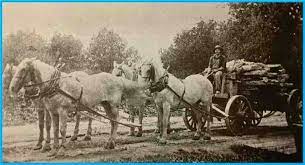
This photo gives us an idea of what it may have looked like. Photo:…cloudfront.net
Two thousand United States Army soldiers arrived in San Antonio in 1846 under the leadership of Brigadier General John Wool. When they arrived, they set to work and acquired part of the Alamo complex for the Quartermasters Department. Over the next eighteen months, the convent building ( now referred to as the long barracks ) was restored and converted into offices and storerooms.
However, at this time, the chapel continued to remain vacant while the church and the army squabbled over who owned the property. The Texas Supreme Court stepped in, and in 1855, they deemed that the Catholic Church was the rightful owner of the chapel. Interesting to note that during this litigation, the army rented the chapel from the church for $150.00 a month.
While they were tenants the army set about to repair the Alamo. Walls were rebuilt from rubble, and the grounds were tidied up and cleared. Around this time, a new wooden roof was restored to the chapel, and the facade that we know today, a campanulate, or bell-shaped frontage, was added.
In 1861, a fire destroyed the installed roof, so it had to be replaced, and the army also created additional windows to the chapel. Two were on the upper level of the new facade, and there were more created on three other sides of the building.

The Alamo c1870…KSAT
The building was eventually used as a blacksmith’s shop, stables, offices and for the storing of supplies.

Photo: Raba Collection…San Antonio Conservation Society Foundation
On December 1st, 1877, Honoré Grenet purchased the Convento building and the adjacent courtyard from the Catholic Church
ANTHONY DOMINJC [sic] PELLICER, General Warranty deed,
BISHOP OF SAN ANTONIO, Dated Nov. 30, 1877.
to Filed Dec. 1, 1877.
HONORÉ GRENT [sic]. Recorded in Book 7, p. 373, Deed Records, Bexar Co., Tex.
Consideration: $20,000 paidI, Anthony Dominic Pellicer, as Bishop of the Roman Catholic Diocese of San Antonio, Texas, etc.
Do grant, bargain, sell, release and convey unto the said Honoré Grenet, his
heirs, assigns, all tha t [sic] lot or parcel of land lying and being in the County of
Bexar, State of Texas, City of San Antonio, and described as follows:
Commencing at the S. W. corner of the old convent building. Thence runtiing [sic]
in Hi E. along the outer face of the west wall of the said convent building 191
feet to the N, W. corner of said old convent building. Thence along the south
boundry line of Houston street S. 78f E. 147 22/100 feet to a point in a line with
the east wall of the old convent building. Thence running in a line with said old
wall and towards it S. 11 W. 84 72/100 feet to the northeast corner of the old
convent yard. Thence S. 78f E. 73 feet to a stake on the.west [sic] bank of the Alamo
Ditch. Thence down along the bank of said Ditch to point in line with the south
wall of the old convent building and yard for the southeast corner ot tnis [sic] lot.
—19—
Thence N, 78J W, running in a line with the south wall of said convent yard
and building about 198—to the place of beginning,
ANTHONY DOMINIC PELLICER,
(Seal) Bishop of San Antonio,
Courtesy of “The Message of Governor O.B Colquitt to the Thirty Third legislature relating to the Alamo Property ” 1913
Honoré Grenet then set about constructing a two story complex that served as a mercantile store, and a museum honoring the Alamo. Atop his building were three wooden towers that featured wooden cannons protruding from each tower.

From the San Antonio Daily Express

Photo: Honoré Grenet’s store. The Raba Collection….San Antonio Conservation Society Foundation

Photo: Honoré Grenet’s “Alamo Warehouse”….Pinterest
According to William E. Green writing in “American Heritage” in June 1986, “ After extensively renovating the barracks, Grenet opened his general store in 1879, running newspaper advertisements that urged locals to “Remember the Alamo—Shop at Grenet’s.”
From the San Antonio Express News in 2021, Paula Allen writes, “Advertisements for the store, which used the Alamo church building as a warehouse, proclaimed Grenet to be a “wholesale grocer and general commission merchant, importer of wines, liquors and cigars, dry goods, boots and shoes, china, crockery, clothing, glassware and fancy goods.”

Photo: San Antonio Daily Express
There are historians today who are critical of the Grenet building, however, this is not new. Here is an extract from a tourist to San Antonio to a newspaper in Galveston in 1881…
“It’s a strange, very strange mingling of fame and sourkraut [sic], and still stranger the fact that the great State of Texas … should permit a historic building like the Alamo … to become a grocery warehouse”
Author William Corner in his 1890 “San Antonio de Bexar…a Guide and History” called the Grenet construction an “inartistic erection” and “an atrocious lumber building” atop the foundation of the convent and used the Alamo chapel for storage.”

Photo: Honoré Grenet’s “Alamo Warehouse”….DeGolyer Library, Southern Methodist University
When Honoré Grenet operated his mercantile store there, he had an intricate keystone carved for the entrance to the establishment. It consists of carved limestone with his initials “H G” intertwined with the date 1878 carved below the initials. It is no longer there. The stone is currently in storage at the Alamo and there are plans to display it in the future.
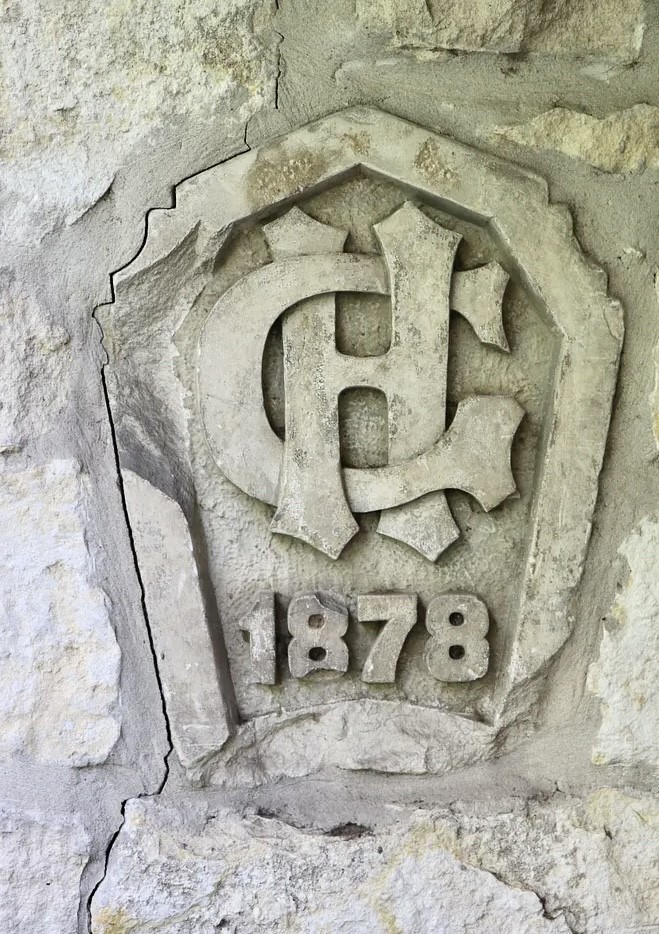
Photo: officialalamo.medium.com
Honoré Grenet passed away in February 1882, and his public eulogy in the newspaper, and his funeral notice demonstrate the regard he had in the city at the time.

Courtesy: San Antonio Evening Light

Courtesy: San Antonio Evening Light
His estate sold the store / long barracks building to another established mercantile business in San Antonio “Hugo & Schmeltzer”
However, “Hugo and Schmeltzer” could not continue using the chapel as a warehouse as the Catholic Church had sold it to the state of Texas, and this action halted any use of the building for commercial purposes.
Their business continued on the site of the long barracks until 1905 when the property was purchased by Clara Driscoll who acquired it on behalf of the Daughters of the Republic of Texas. This began another chapter in the story of the Alamo that some refer to as “The Second Battle of the Alamo”
Today, Honoré Grenet has an elaborate headstone over his grave in San Antonio.

Author’s photo
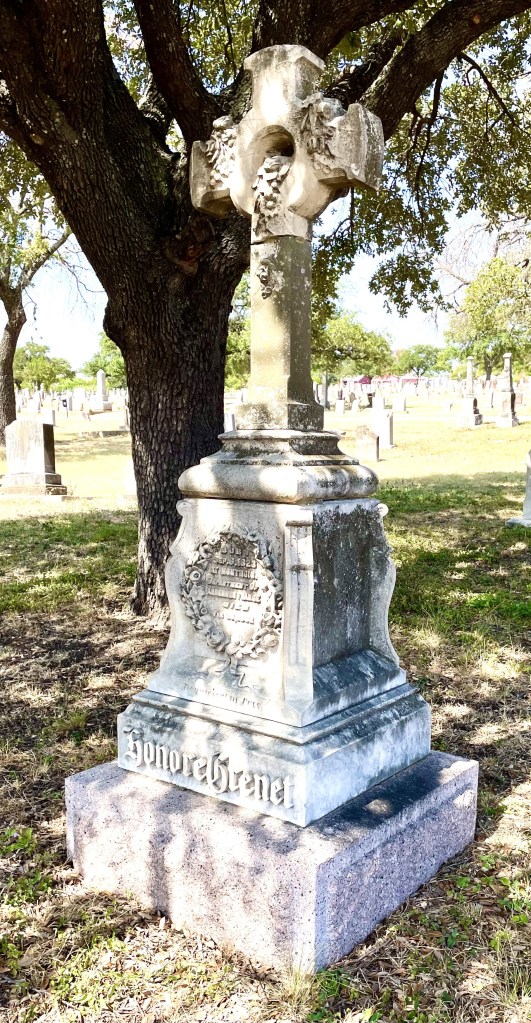
Author’s photo

Author’s photo
Author’s note :
I want to conclude this story by mentioning that Honoré Grenet was, and has been, criticized for his venture and his usage of the Alamo and long barracks / convento. In his own way he attempted to keep the Alamo, which had fallen into disrepair, from even further damage. The published public eulogy and size of his funeral show the regard and respect he had by his contemporaries in San Antonio. He was involved with many community committees and groups to promote the city.
Additional story:
- In a previous post here on “Memories of San Antonio”, there is the story of the first ice factory in the city. It was located on the San Antonio Riverwalk where today you will find the restaurant “Mad Dogs and Englishmen” The factory was opened by Jean Batiste LaCoste in 1868. Here’s the link to see that Memory…
https://wordpress.com/post/memoriesofsanantonio.com/1036

Photo: Jean Batiste LaCoste…digital.utsa.edu
Jean Batiste LaCoste went into this ice-making business with other prominent French residents in San Antonio at that time including Joseph Brunet and Honoré Grenet.
Sources:
San Antonio Express News and Paula Allen
postcardsfromsanantonio.com
San Antonio de Bexar….William Connor
Genealogies of Early San Antonio Families..…Frederick C. Chabot
Saving San Antonio…Lewis F. Fisher
stillcurrent.blog
officialalamo.medium.com
History and Legends of the Alamo and other Missions in and around San Antonio….Adina de Zavala
thealamo.org
colfa.utsa.org
americanheritage.com
Follow My Blog:
Get new content delivered directly to your inbox.
 Memories of San Antonio