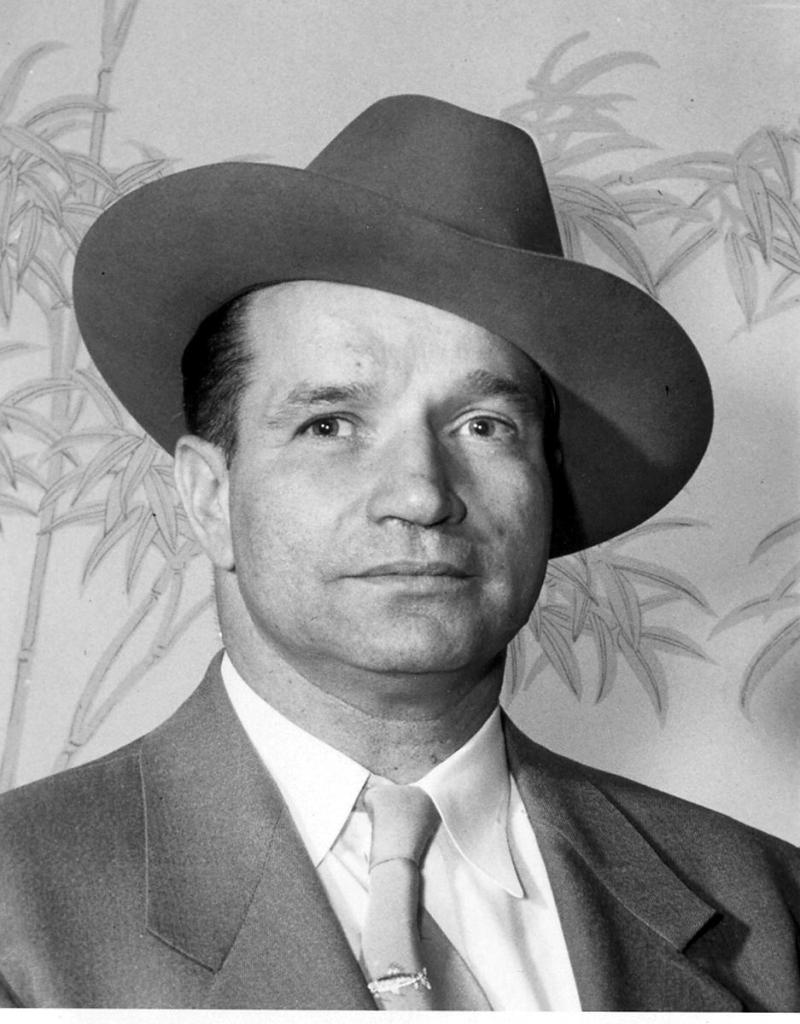
Photo: Perry Kallison…..San Antonio Express News
He was born in San Antonio on November 1st, 1903, the second son and the fourth child of Nathan and Anna Kallison. He made his arrival into the world at the new family home on Mission Street.
His father Nathan was a leather-worker, and specialized in crafting harnesses, halters, horse collars and saddles. Soon after their arrival in San Antonio in 1899, Nathan rented space in a building that was within earshot of the bells of the San Fernando Cathedral. They had moved from Chicago in the hope of finding a healthier climate, and better business prospects in San Antonio.
Nathan Kallison rented this one story wooden building from wool-buyer Col. Theodore H. Zanderson, and it served as a shop for Nathan in the front, with the back two rooms housing the young Kallison family. In those days they only had two children, a son named Morris and a daughter, Pauline. In 1902, another daughter arrived, and soon, the family purchased their first home near the King William area. This house was bought by Nathan Kallison in January 1903 for $1,775.00.
On November 1st, 1903, 120 years ago today, the Kallisons welcomed their 4th child, a second boy that they named Perry. Anna Kallison wanted the best for her four children, and they were all educated at the nearby Bonham School which already had a reputation as one of the city’s finest elementary schools.
Nathan Kallison was beginning to realize that change was coming, with horse-drawn carriages, buggies and drays making way for a new innovation: motor vehicles. With oil wells producing at a rising rate in Texas, he decided to sell his harness and saddle-making operation and diversify his business for a new clientele.
For a period of time, he observed that his customers would shop with him for his leather goods, and then go elsewhere for other agricultural products like seed and feed. At the same time, wives and children would go to other stores in search of clothing and home goods like furniture.
So, Nathan decided to make his establishment a farmer’s version of the successful Joske’s store, and this made his shop a one-of-a-kind business in San Antonio.
The Kallison store became widely known as the place to go for things like branding irons, windmills, plumbing supplies, baby chickens, feed, barbed wire, cowboy hats and boots, tools, nails, fertilizer, veterinary medications, and many more items on an agricultural shopping list. Ambitiously, he called it “Kallison’s Department Store”

Photo: San Antonio Light
The decision was also made to expand their business and offer plumbing supplies as well.

Photo: San Antonio Express
The Kallison boys were eager to help their parents in the family store. Both were schooled in commerce, and each had their special roles. The oldest child, Morris, assisted his father with the day-to-day tasks, while the younger Perry was given the responsibility of taking the daily receipts to the Oppenheimer Bank on his bicycle.

Photo: A young Perry Kallison….Nick Kotz
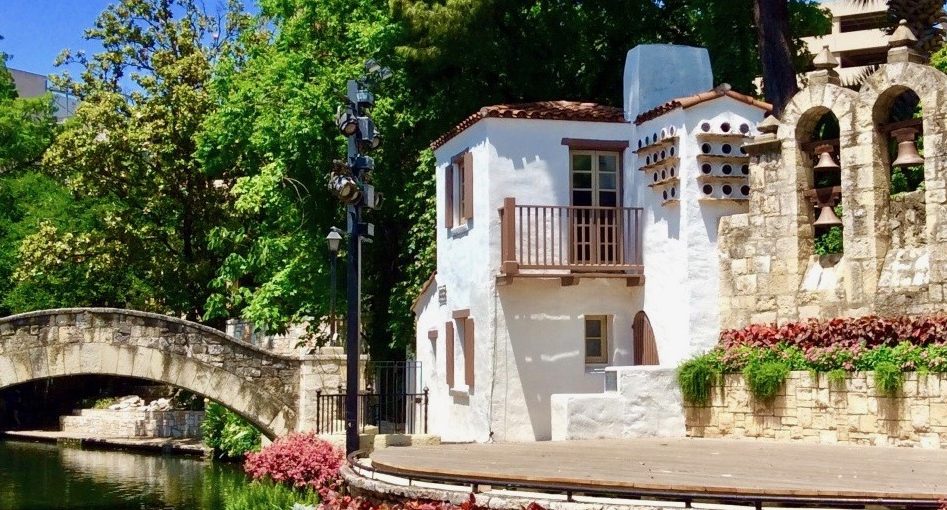
With the increase of business, Nathan Kallison expanded the size of his store, buying adjacent properties, and contracting famed architect Harvey Partridge Smith to design “The Kallison Block” complete with a replica “mission-inspired window.”

Photo: Author
Harvey Partridge Smith is also known for designing the grand mansion for Myer Myers and the famous conjoined twins Violet and Daisy Hilton, the Sunken Garden Theater in Brackenridge Park, and for his restoration of the Spanish Governor’s Palace in downtown San Antonio.

Photo: Author

Photo: Author
With the success of the business, and with a growing family, The Kallisons moved house to a grander residence on San Pedro Avenue, and from here, Perry and his sisters attended Main Avenue High School, where Fox Tech High School now sits. After graduating from High School in 1920, Perry Kallison attended the University of Texas where he studied Business. After a year though, he left the college because he had decided he would rather work in the family store and on their extensive ranch where he learned the latest innovations in agriculture and cattle breeding.

Photo: Jewish Museum of the American West
In 1925, Perry Kallison became a member of the Temple League. Emanating from the Temple Beth-El, it encouraged young Jewish adults to become involved with community activities. They organized musical recitals, debates and plays, and Perry, who already had experience as a debater at school, and despite his partial deafness resulting from childhood illness, threw himself into the activities performing in plays, and performing as a comedian. Although quietly-spoken, young Perry transformed into a talented performer who excelled in one-liners and impersonations. Away from the theater, he served the community as a scoutmaster.
After a decade of increasing prosperity, the United States reeled when the stock market crashed on “Black Tuesday” October 29th, 1929. Daily news stories reported thousands of citizens losing their jobs, their homes, with banks and businesses forced to close. Families had to cut back, going without medical and dental services, and reducing their food costs. Many children were pulled out of school as a consequence, and farming families faced disaster.
Many of those in the agricultural sector lost their properties as their financial plight was magnified by a widespread drought which destroyed crops. Nathan Kallison made his ranch available, and many families took up his offer and lived there under tents. He employed the men by giving them jobs on the farm, and even allowed some to graze a small herd of cattle. Perry would visit the farm with his father, and he bought clothing and supplies for families going through this hardship.
Back at the store, the Kallisons bought in bulk, which allowed them to sell to their customers at greatly reduced prices. They also offered liberal credit with hardly any conditions.
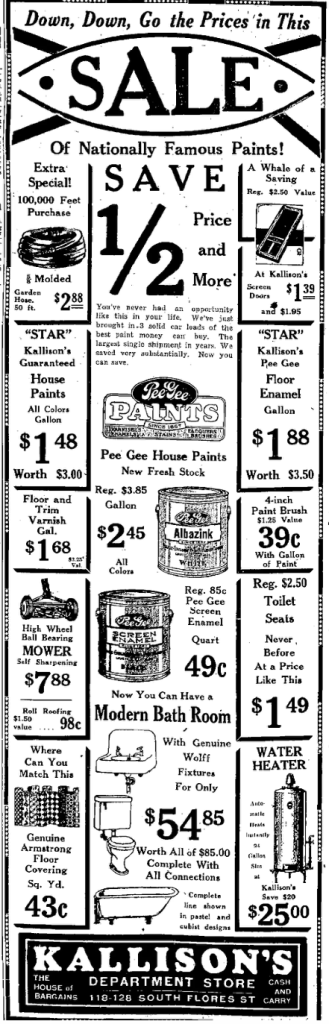
Photo: San Antonio Light
As part of the government program to kick-start the country after the Depression, the Kallison business assisted families to repair or build their homes when they opened a department to service FHA loans, and went on to build new FHA financed homes on homes on Chicago Boulevard, Lee Hall and Catalina Avenue.
During this time, the Kallison family was expanding, and Perry, the youngest, had met Francis Rosenthal. They were married in 1931 and went on to have three children.

Photo: Perry Kallison c. 1931….Nick Kotz
In the summer of 1936, Perry and Francis took a one month road trip across New Mexico. On the trip, he witnessed many trading posts where food and supplies shared shelf space with items made by locals that they had made to sell or trade for goods. This got Perry thinking and inspired him to create another platform in order to advertise and promote the Kallison business, by taking this trading post concept and combining it with modern media in the form of a radio program.
Radio was becoming increasingly popular, not only for entertainment, but also for sharing news and information, and radio sets were now very affordable. Perry devised a program that would not only benefit the store, but would also allow people to buy, sell or trade items on air. His name for the show was the Trading Post.
Originally a professional announcer hosted the show, but after a night of drinking the announcer was not in any condition to go on air, so it was up to Perry to step up and take over.
His natural style and competency, developed as a young performer, soon endeared him to listeners. Soon, Perry was known as the “Old Trader” as he broadcast through KTSA in San Antonio to a 300 mile radius of San Antonio.

Photo: Jewish Museum of the American West
Not only did he deliver the news, but also stock prices and developments, and became a friend to many living in outlying areas. It was also a vehicle to advertise the Kallison goods, and people would constantly visit the store to purchase those items, but also to meet the “voice” that had become part of their lives.
The “Old Trader” loved to meet the visitors who brought stories with them that he used on the show, but also supplied birthdays, anniversaries, graduations and other events that he could use. He also won many fans with his weekly “Sermonettes” where he could express his opinions and philosophies. The show’s popularity grew, and Perry would then visit livestock shows around Texas to stay in touch with listeners but also to witness their lives.
Over the ensuing years, the show moved to different radio stations

Photo: San Antonio Express

Photo: San Antonio Express
During the run of the show, one of his guests was Lyndon Baines Johnson who visited the studio in person on two occasions to conduct an interview with Perry in the hope of securing electoral victory. He did, and he always gave credit to Perry for the assistance he gave.
The show even went on the road to the San Antonio Stock Show where people could see Perry in action for themselves.
In between announcing duties and working in the Kallison store, Perry still found time to look after the Kallison Ranch in his ever-present Stetson. He was a true cattleman and was widely respected for his knowledge of farming and cattle breeding. He became an expert at breeding Polled Herefords.
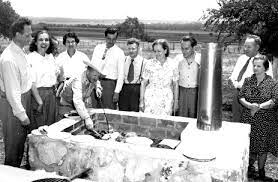
Photo: Perry Kallison looking after the bar-b-q for ranch guests…Jewish Museum of the American West
Sadly, on December 3rd, 1944, Nathan Kallison, the father of Perry and the founder of the whole business, passed away following a third stroke. He was seventy one years of age leaving behind a great legacy.
Following the WWII, the Kallison store went from strength to strength under the leadership of Perry and his older brother Morris.
Embracing new technology, the Kallison brothers eagerly purchased home freezers, and then “educated” customers to use them.

Photo: San Antonio Express
Over three thousand people turned up and the store had to put television sets in their parking lot behind the building so that those who could not get inside could still witness the event.
Now known as “The Big Country Store” Kallisons branched out into other appliances and home furnishings and the building expanded. What was once a one-room harness and saddle making shop, was now a 60,000 square foot store that ran down South Flores from Dolorosa almost to Nueva Street.
Perry Kallison was also deeply involved with the community, and can be credited with driving the establishment of what would become the Freeman Coliseum and the subsequent San Antonio Livestock Exposition and Rodeo.
He was also actively involved with the Red Cross and the March of Dimes program in San Antonio to combat polio. Along the way there was also involvement from Perry in Goodwill, Boysville, the support of 4-H clubs around Texas, and the San Antonio Zoological Association. The San Antonio chapter of the National Association of Christians and Jews presented him with their Brotherhood Award in 1958.
In 1967, the family business closed, and the Kallison building was sold. Perry, who was 64, suffered further with the sale of the Kallison Ranch and its herd of Polled Herefords. Over the decades, the family had won numerous prizes for their cattle, and it was recognized as among the best-breeding stock in the country.
Perry however refused to give up, and subsequently opened a small farm store on Nogalitos Street, still selling barbed wire, medicine and other farm supplies but on a much smaller scale.
Right up until April 26th, 1981, Perry Kallison continued to broadcast his radio show from his home, but following a station format change, the program had run its course. Age had wearied him, and Perry finally closed his small store, and suffering from dementia, Perry Kallison passed away on February 13th, 1999 at the age of ninety five.
Rabbi David Jacobson in his eulogy said of Perry Kallison: ”He was an expansive, warm man, steeped in the pride of South Texas, belonging to a generation who felt obligated and duty-bound to serve their communities.”

Photo: Author
In 2000, the San Antonio Livestock Exposition inducted Perry Kallison into its Hall of Fame.
Additional stories:
- The site of the 2,563 acre Kallison Ranch is today occupied by a new home community….and a large portion of Government Canyon.

Photo: Author
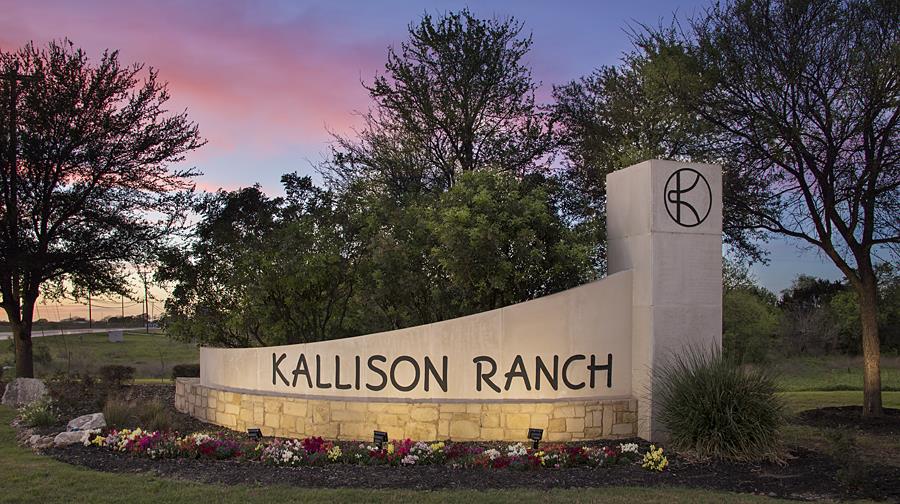
Photo: Perry Homes
- After the flagship Kallison store closed in 1967, the iconic concrete cowboy who had adorned the building stayed in place “ guarding” the store until around until 2000 when the new owners had it removed, and according to an article by Paula Allen in The San Antonio Express News on April 27, 2019, Ryan Badger, the assistant curator of the Briscoe Western Art Museum said that the statue is not destined for the museum. Instead he said that it was his understanding that “The cowboy will be returned to its traditional place after restoration is complete.”

Photo: Library of Congress
Sources:
The Harness Maker’s Dream Nick Kotz
San Antonio Express News
San Antonio Light
Jewish Museum of the American West
Follow My Blog:
Get new content delivered directly to your inbox.
 Memories of San Antonio